
DEA Scheduling Action Confirms Chemically Manipulated 7-OH Opioids Are Not Kratom
American Kratom Association calls on state officials to stop protecting 7-OH profiteers and act immediately to remove dangerous products from the marketplace
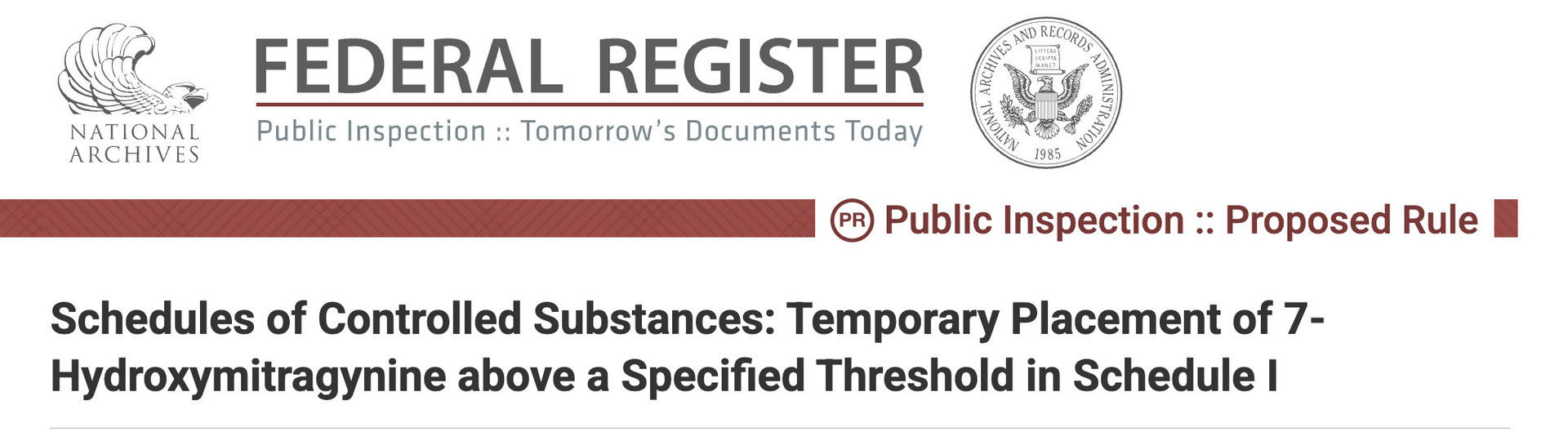
The American Kratom Association (AKA) today supported the Drug Enforcement Administration’s (DEA) announcement of its intent to temporarily schedule high-potency 7-hydroxymitragynine, commonly known as 7-OH, and its follow-on products under Schedule I of the Controlled Substances Act.
The DEA action confirms what the AKA has repeatedly warned state and federal policymakers: chemically manipulated 7-OH opioid products are not natural kratom leaf products. They are high-potency opioid products that have been falsely marketed as “kratom” while exposing consumers to serious and unnecessary risks.
“This DEA action should end the debate,” said Mac Haddow, Senior Fellow on Public Policy for the American Kratom Association. “Chemically manipulated 7-OH opioids are not kratom. They are dangerous products that exploited the reputation of natural kratom leaf, misled consumers, and created a public health threat that responsible regulators can no longer ignore.”
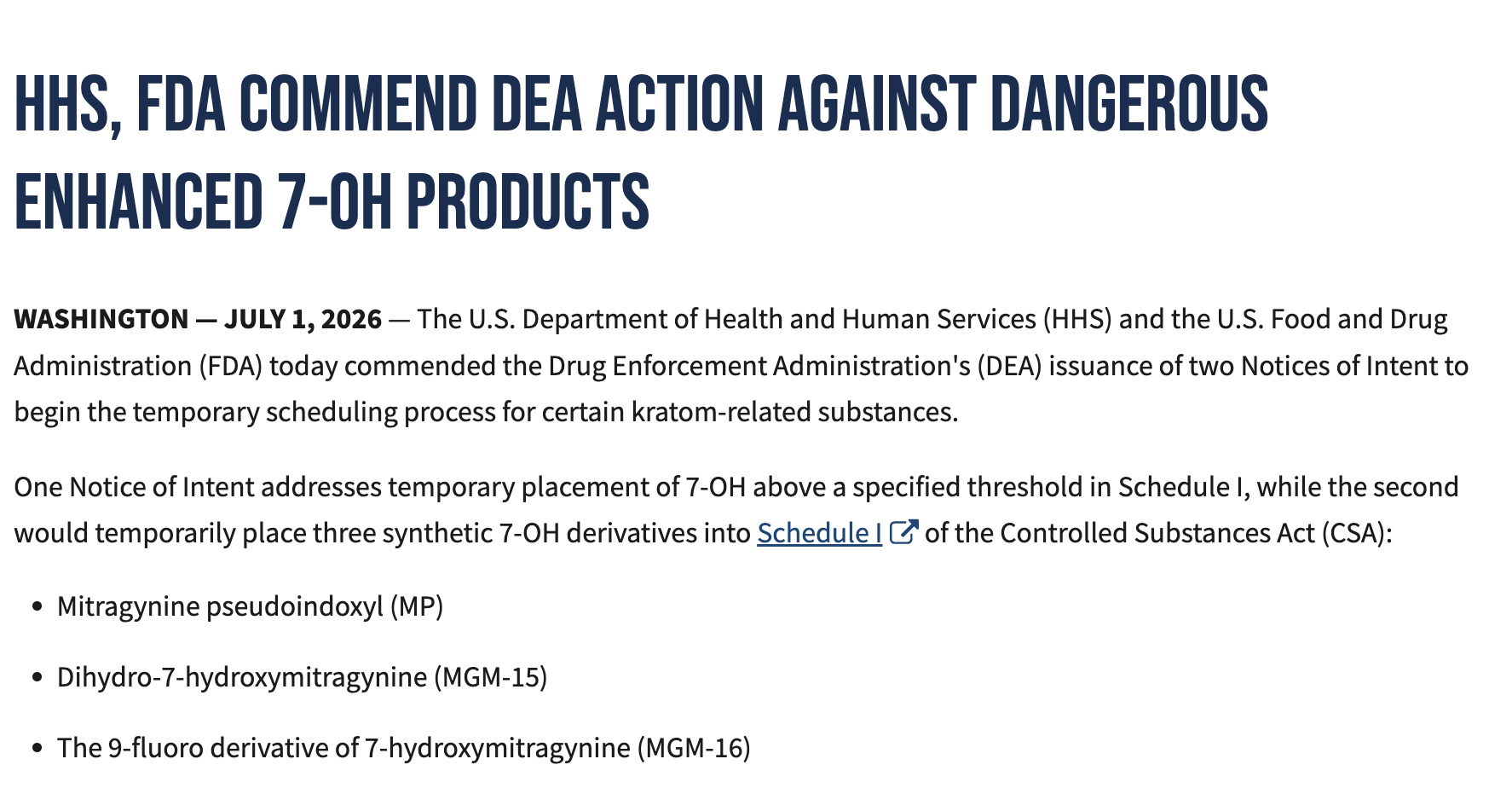
HHS Secretary Robert F. Kennedy, Jr., echoed that position in an official HHS statement commending the DEA, saying:
“I commend the DEA for taking decisive action to address these addictive and harmful substances. 7-OH, MP, MGM-15, and MGM-16 are dangerous opioids that fuel addiction and put American lives at risk. HHS reviewed the science and recommended this action. The Trump Administration will continue using every available authority to stop these deceptive products, hold bad actors accountable, and protect American families.”
These actions are not intended to regulate natural leaf kratom that does not contain enhanced levels of 7-OH. Although 7-OH occurs naturally in trace amounts in the kratom plant, scheduling 7-OH above a certain threshold level does not intend to capture the kratom botanical leaf in the present temporary scheduling recommendation. MP, MGM-15, and MGM-16 do not occur naturally in the plant. MP is a chemical rearrangement product of 7-OH, while MGM-15 and MGM-16 are synthetic derivatives of 7-OH.
DEA’s notice targets 7-OH above a specified threshold and includes related forms such as isomers, esters, ethers, salts, and follow-on products. That distinction is critical. Natural kratom leaf contains only trace or very low levels of 7-OH. The products now flooding the marketplace are different. They are concentrated, isolated, converted, or chemically manipulated products designed to deliver powerful opioid-like effects.
“State officials should be very clear about what happened here,” Haddow said. “The 7-OH industry created this crisis. They manufactured or distributed high-potency opioid products, dressed them up as kratom, and then tried to force natural kratom consumers to pay the price for their recklessness.”
The AKA is calling on governors, attorneys general, state legislatures, health departments, pharmacy boards, and law enforcement officials to take immediate action to remove chemically manipulated 7-OH opioid products and their derivatives from the marketplace.
“Any state official still claiming that 7-OH products are just another form of kratom is ignoring the science, ignoring DEA, and ignoring the growing evidence of harm,” Haddow said. “Natural kratom leaf should be responsibly regulated. 7-OH opioid products should be banned.”
The AKA has consistently supported state and federal policies that preserve access to properly manufactured natural kratom leaf products while banning unsafe synthetic, semi-synthetic, chemically manipulated, adulterated, or mislabeled products. Responsible kratom regulation should include age restrictions, accurate labeling, serving-size disclosures, contaminant testing, good manufacturing practices, and strict limits on 7-OH content.
“What lawmakers should not do is use the 7-OH crisis as an excuse to ban natural kratom leaf,” Haddow said. “That would reward the very bad actors who created this problem. The right answer is to shut down the 7-OH opioid marketplace and protect consumers who rely on safe, natural kratom leaf products.”
The DEA announcement also exposes the failure of policymakers who have accepted misleading claims from 7-OH manufacturers and distributors that their products are “natural” simply because 7-OH can occur in trace amounts in kratom leaf or as a metabolite of mitragynine in the body.
“That argument was always deceptive,” Haddow said. “The fact that trace amounts of 7-OH may occur naturally does not justify selling chemically manipulated, high-dose 7-OH opioid products in gummies, tablets, shots, strips, nasal sprays, and other rapid-delivery forms. That is not natural kratom. That is a dangerous chemical manipulation of kratom alkaloids.”
The AKA also warned that medical examiners, coroners, and public health agencies must stop using broad and misleading “kratom-related death” categories that fail to distinguish between natural kratom leaf, adulterated products, polydrug intoxications, and chemically manipulated 7-OH opioid products.
“DEA’s action makes precision essential,” Haddow said. “When public health officials lump everything together as ‘kratom,’ they mislead lawmakers and the public. That confusion has allowed 7-OH profiteers to hide behind natural kratom consumers while selling products that responsible kratom advocates have opposed from the beginning.”
The AKA is urging states to immediately adopt or amend consumer protection laws to:
- Ban chemically manipulated 7-OH opioid products and derivatives;
- Prohibit synthetic, semi-synthetic, converted, or concentrated 7-OH products falsely marketed as kratom;
- Preserve lawful access to natural kratom leaf and properly manufactured kratom products;
- Require clear serving-size labeling, age restrictions, contaminant testing, and good manufacturing practices;
- Enforce against mislabeled, adulterated, and rapid-absorption products designed to evade responsible regulation.
“This is a defining moment for state policymakers,” Haddow said. “They can stand with consumers and science, or they can continue allowing 7-OH profiteers to endanger the public and destroy trust in the kratom marketplace.”
The American Kratom Association stands ready to work with DEA, FDA, HHS, Congress, governors, attorneys general, state legislatures, and responsible industry participants to remove dangerous 7-OH opioid products from the marketplace while preserving access to properly regulated natural kratom leaf.
“The message to every state official should be simple,” Haddow said. “Do not ban kratom because of 7-OH. Ban 7-OH because it is not kratom.”
About American Kratom Association (AKA)
American Kratom Association (AKA) is a consumer-based, nonprofit organization, focused on furthering the latest science as guidance for kratom public policy. AKA works to give a voice to millions of Americans by fighting to protect their rights to access safe and natural kratom. For more information, visit www.americankratom.org and learn more at kratomanswers.org.
Media Contact
Mac Haddow
Senior Fellow on Public Policy
press@americankratom.org
+1 571-294-5978